
Disclosure: This article contains affiliate links to PracHub. If you buy a Premium subscription through one of these links, we earn a commission at no extra cost to you. Our assessment is based on our own hands-on test of the platform in September 2026.
If you are preparing for an interview at Google, Stripe or OpenAI, you eventually hit the same question: what do they actually ask? LeetCode gives you algorithms. Glassdoor gives you fragments. PracHub promises to combine the two, with questions from real interviews sorted by company, role and round.
We spent time with the platform to see how well that promise holds up. This review covers what PracHub offers, where its limits are, and who gets real value out of a Premium subscription.
PracHub at a glance
PracHub is an English-language platform for technical interview preparation. At its core is a question bank that candidates fill after their interviews and that PracHub then edits and organizes. Around it you find interview experience reports, courses, company guides and personalized cheatsheets.
The numbers at the time of our test:
| Area | Size (September 2026) |
|---|---|
| Interview questions | about 11,000 from 542 companies |
| Experience reports | 4,086 |
| Company guides | 804 guides covering 771 companies |
| Courses | 12 courses with 794 lessons |
| Target roles | Software Engineer, Data Scientist, ML Engineer, Product Manager, Data Engineer |
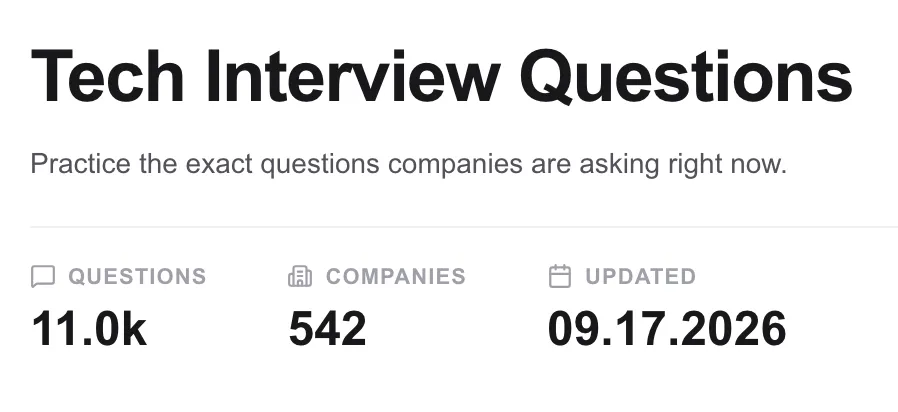
The question bank: the heart of the platform
You can filter the question bank by seven criteria: company, role, category, difficulty, interview round, seniority and your own progress status. That means you can search for something as specific as “Meta, senior, onsite, system design” and get exactly the questions reported for that combination. On top of that, the “Most Popular” and “Latest” tabs sort the results, and a “Knowledge Hub” collects background material.

Behavioral and team fit questions
Coding tasks make up the largest share. Alongside them you will find plenty of questions on team fit, conflict and leadership. One example is the Microsoft question “Describe resolving a conflict with a teammate” from a technical screen for a data scientist role. PracHub lists what a complete answer should cover and the follow-up questions an interviewer is likely to ask.

This is where the platform adds real value. When you prepare for a behavioral interview, you rarely get such concrete hints about which follow-ups to expect.
Model answers and community answers
Many questions come with separate tabs for the problem, a worked solution and answers from the community. The model answer to the conflict question builds on the STAR method and adds details that matter specifically for data scientists, such as agreeing on success metrics like AUROC or precision@k.
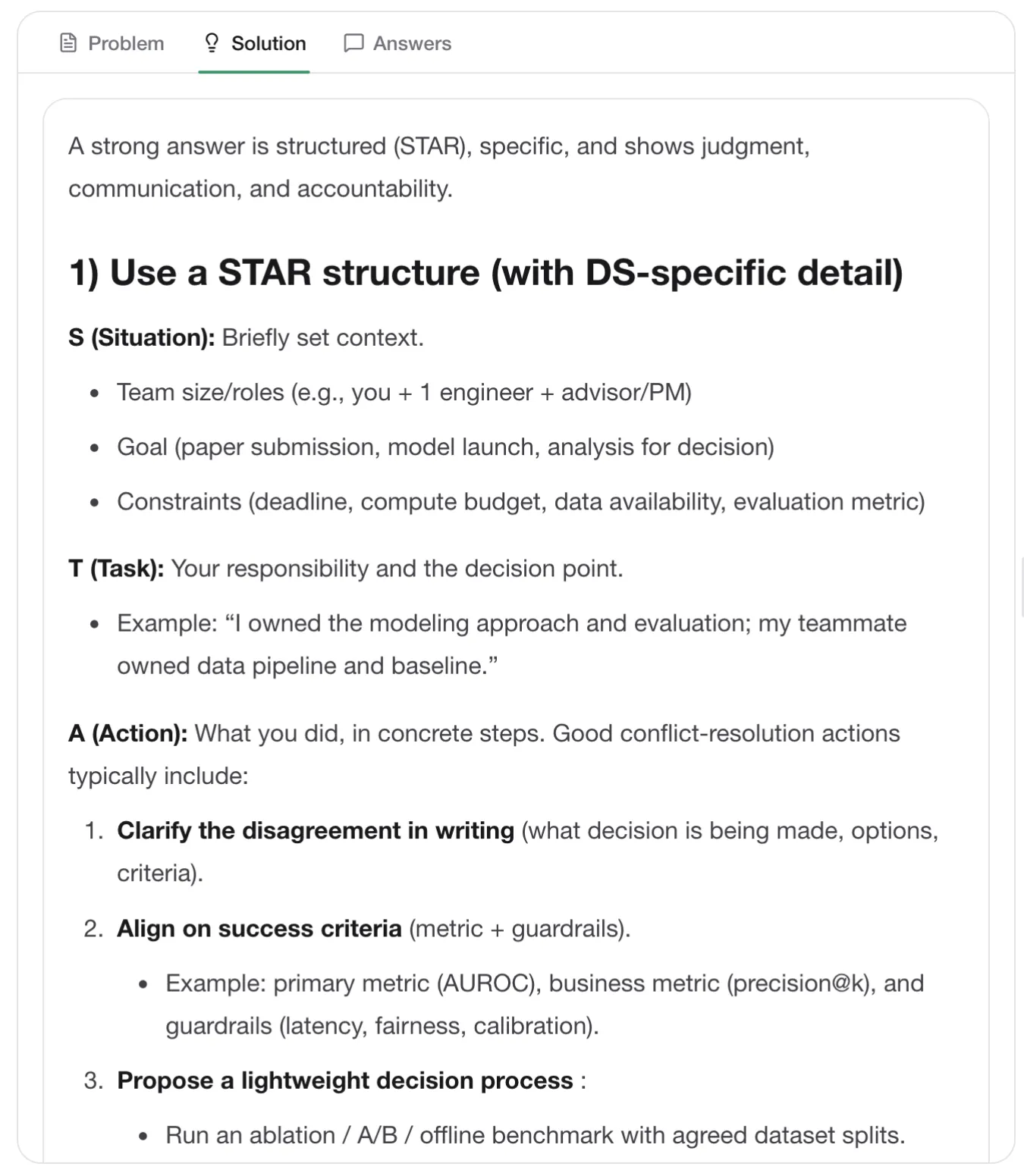
An “Ask AI” button lets you ask follow-up questions about a task. The “Question / Experience” toggle switches between the question and the candidate report it came from.
Weak spot: no notebooks for data science
Data scientists miss one important tool. Tasks like “Compute and plot a precision-recall curve” appear as plain text. There is no runnable notebook where you could test your code and see the plot. For this particular question the solution tab was also missing, and there was exactly one community answer.
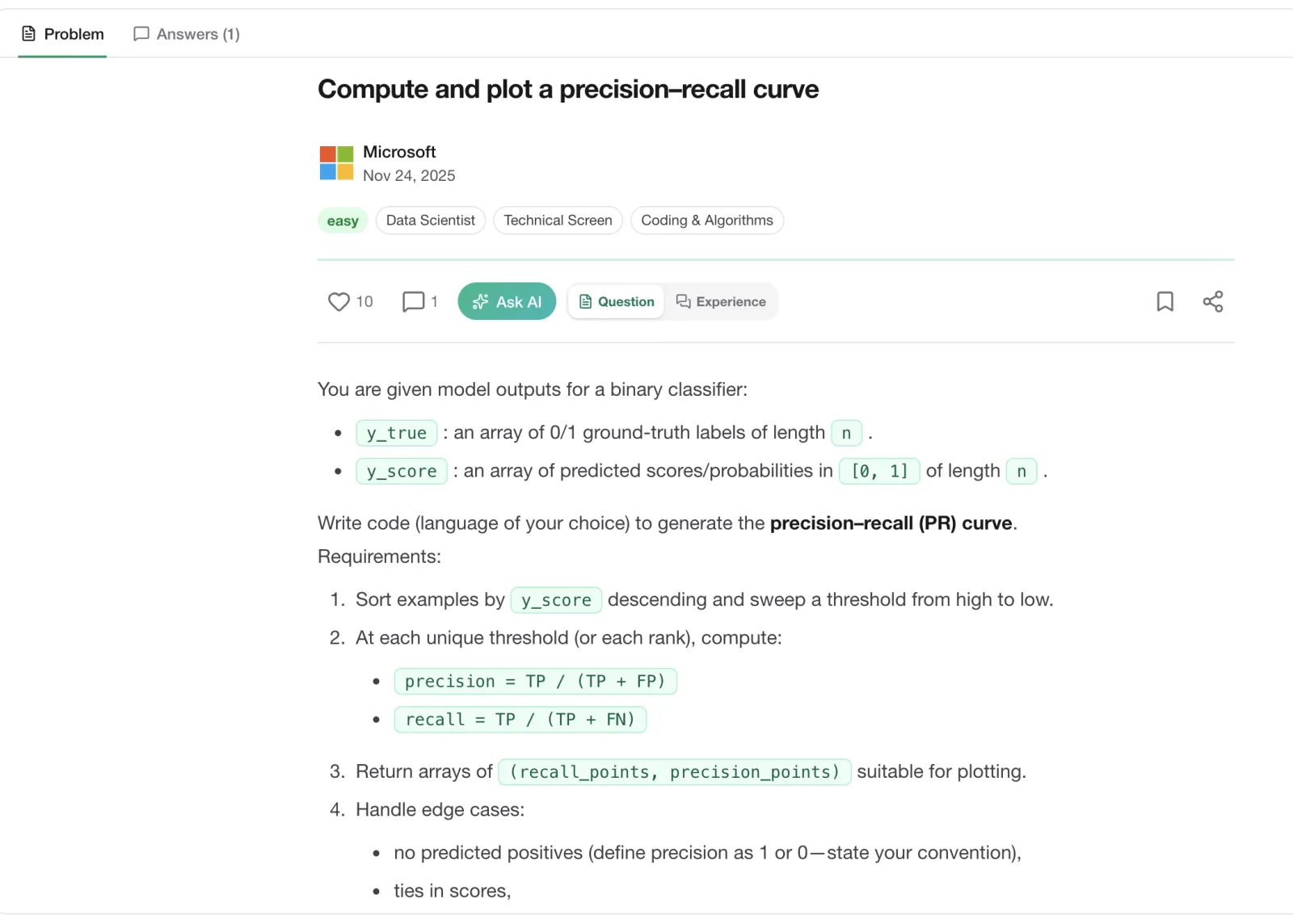
For tasks like this you still need a local Jupyter setup or Google Colab.
Interview experiences from real candidates
In the “Interview Experiences” section, candidates describe their entire loop: which rounds they had, what they were asked and how it ended. More than 4,000 reports can be filtered by company, role, round and seniority. Rejections are clearly labeled, which makes the reports more credible than a feed of success stories.

The reports often reveal more than the questions do. One candidate describes how a Cisco process moved from the HR screen to a logic puzzle instead of a coding task. You will not find surprises like that in any official preparation guide.
One caveat: sharing a report earns you XP points. That encourages people to contribute, and it can also encourage thin reports. PracHub marks reviewed entries as “Curated”.
The courses: 12 structured learning paths
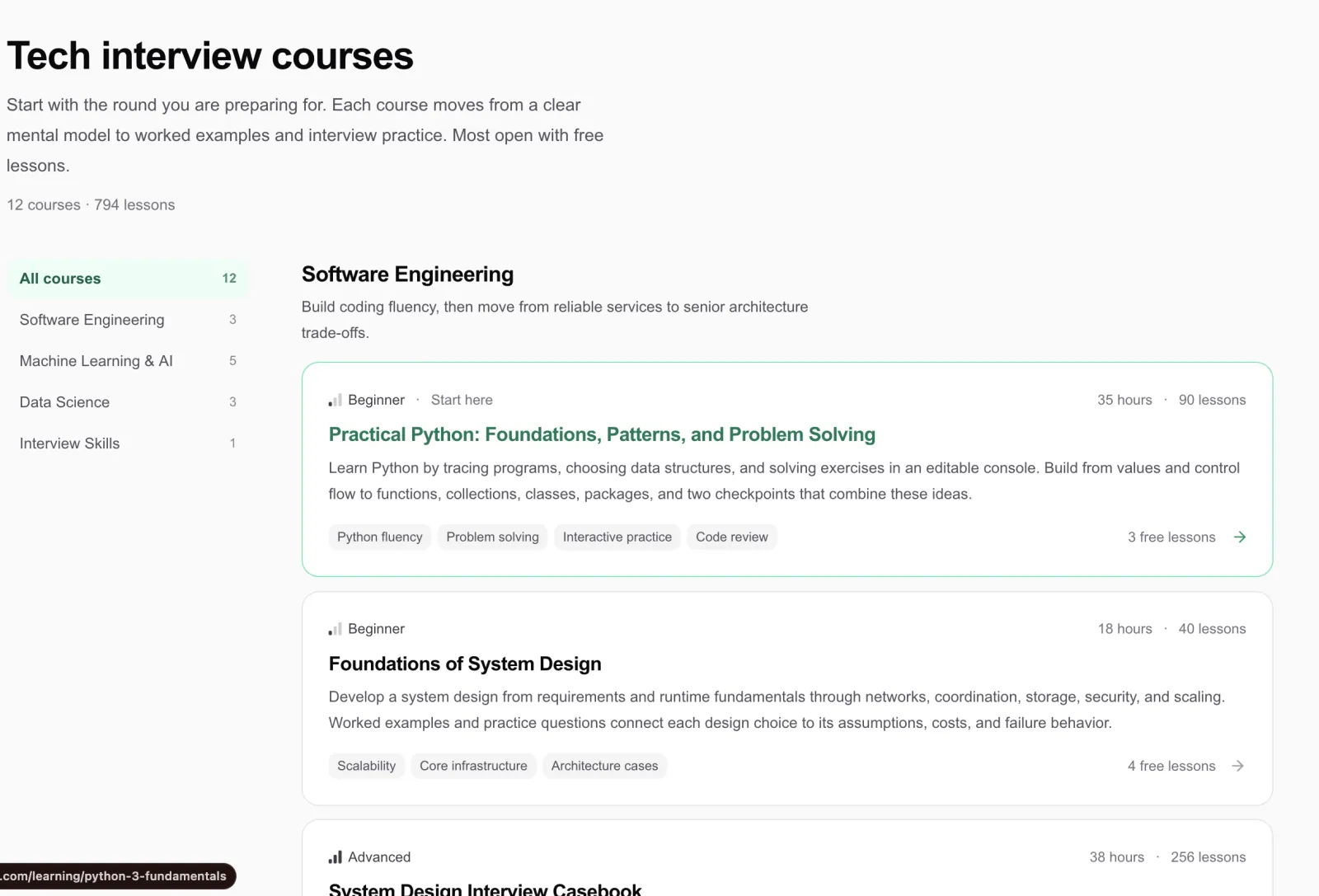
Under “Learning”, PracHub offers 12 courses with 794 lessons in total across four areas. Every course opens with a few free lessons, so you can judge the quality before paying.
| Area | Courses | Length |
|---|---|---|
| Software Engineering | Practical Python, Foundations of System Design, System Design Interview Casebook | 18 to 38 hours per course |
| Machine Learning & AI | Generative AI Systems, AI Agents, How LLMs Work, ML Interview Playbook, ML System Design | 18 to 29 hours per course |
| Data Science | Product Data Science, Data Science Projects, A/B Testing | 12 to 30 hours per course |
| Interview Skills | Behavioral Interview Mastery | 13 hours |
Software engineering
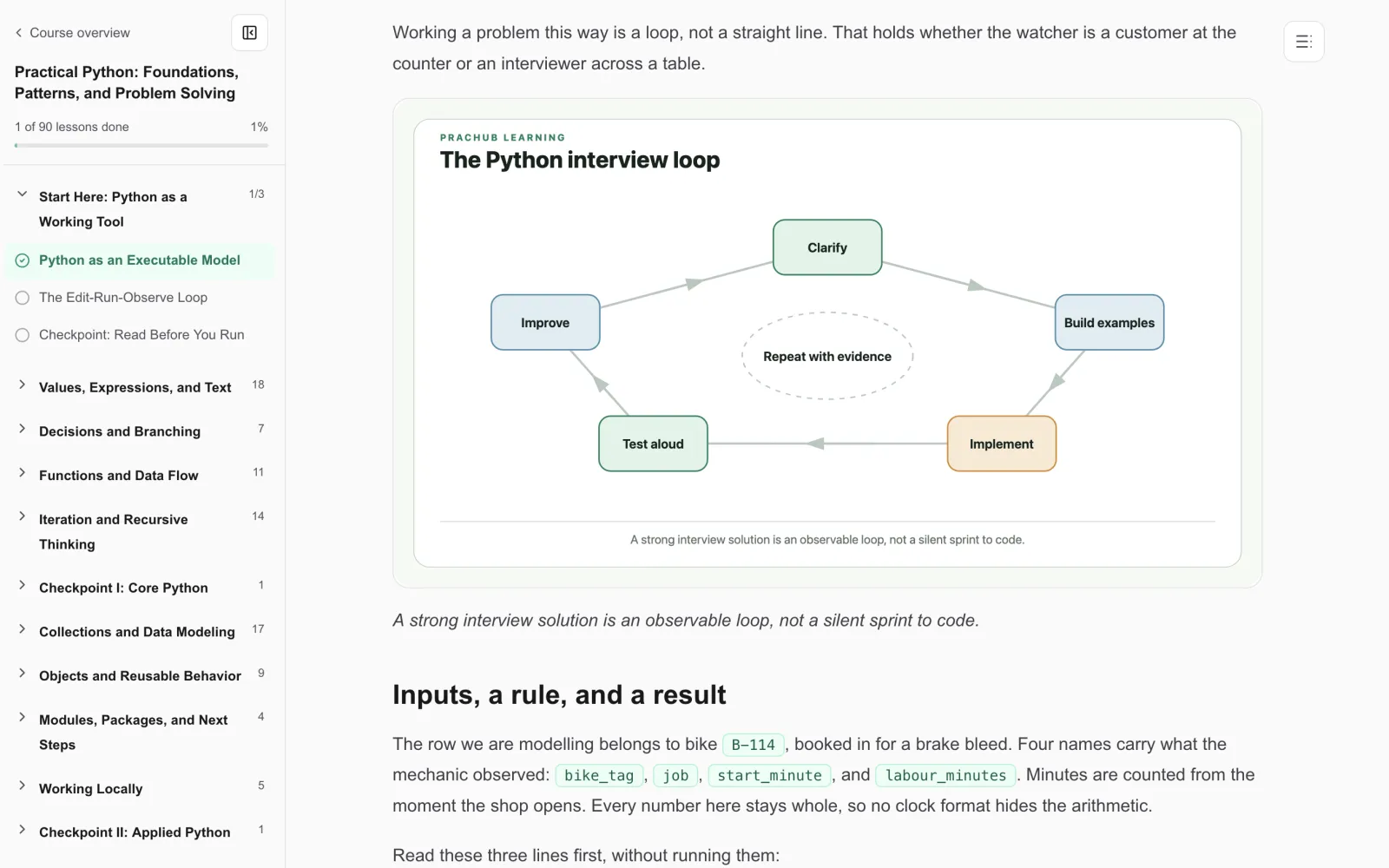
The entry-level course “Practical Python” has 90 lessons and explicitly targets beginners with no programming background. It is built around interviews from the first lesson, which explains that a strong interview solution is a visible loop of clarifying, building examples, implementing, testing out loud and improving. You solve exercises in an editable Python console in the browser.
Experienced engineers will get more out of the “System Design Interview Casebook”. With 256 lessons, 9 of them free, it is the largest course on the platform. If you want to compare it with other material, our overview of system design interview resources lists books and courses worth knowing.
Machine learning and AI
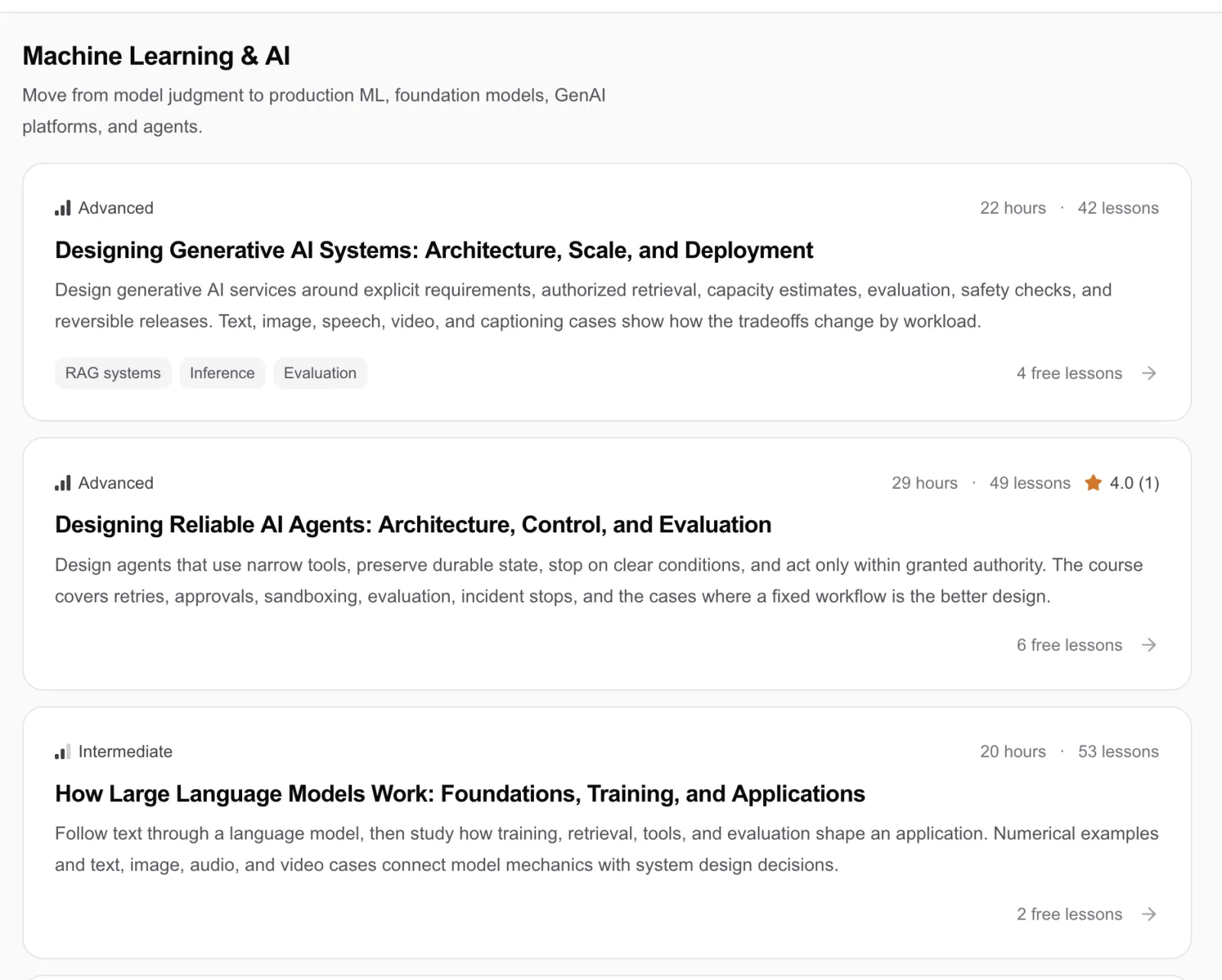
With five courses, this is the best-stocked area. Topics like designing reliable AI agents or generative AI systems with RAG and evaluation are still hard to find at this depth on other interview platforms.
Data science and interview skills
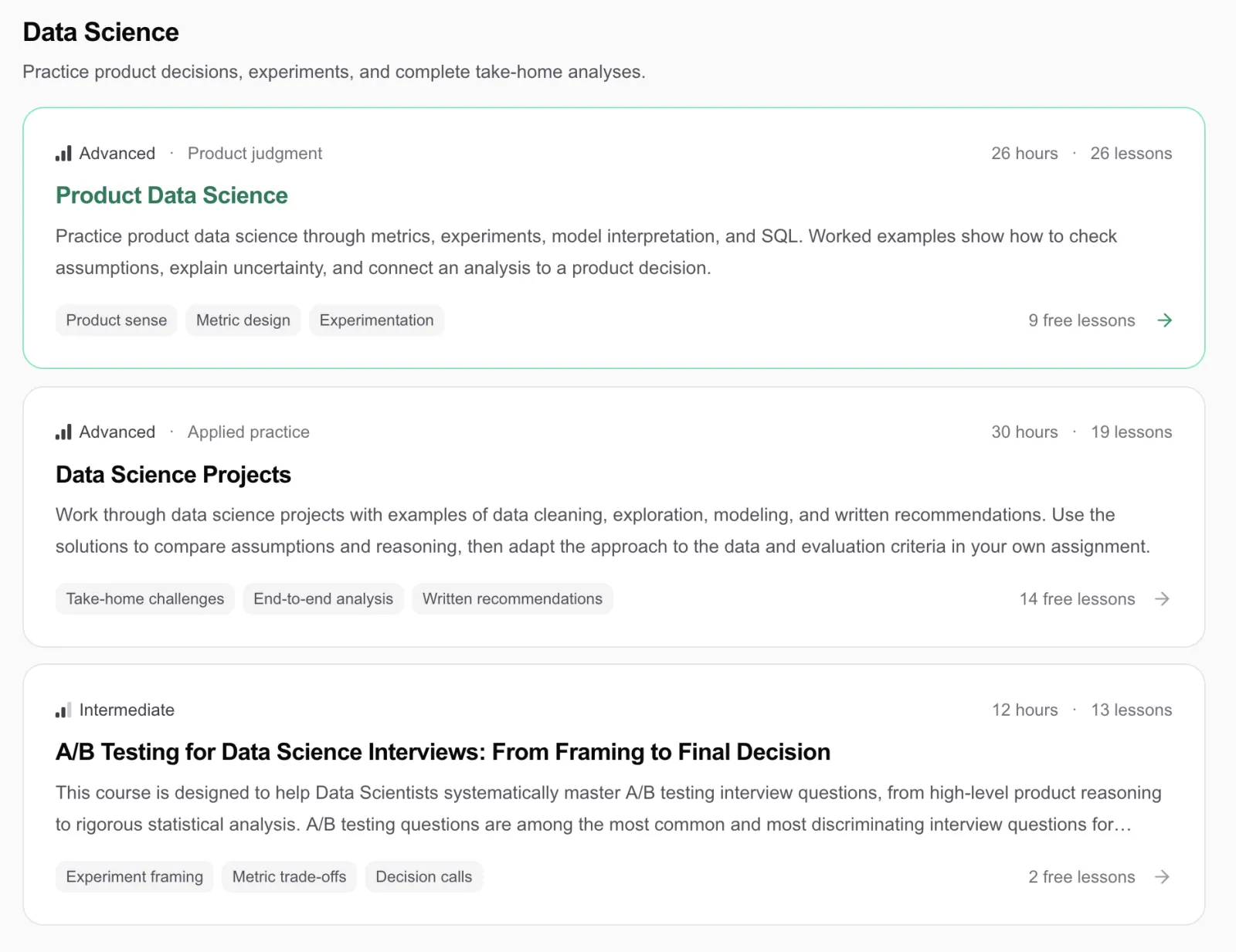
The data science courses cover product metrics, experiments, take-home projects and A/B testing. “Data Science Projects” has the most free content of any course with 14 free lessons. The interview skills area has a single course on behavioral interviews, with role-specific strategies for SDE, MLE, data scientist and Amazon interviews.
Interview guides for more than 770 companies
The company guides are the strongest feature in our view. PracHub lists 804 guides for 771 companies, most of them for software engineers (761). Data scientists get 28 guides and ML engineers 10.
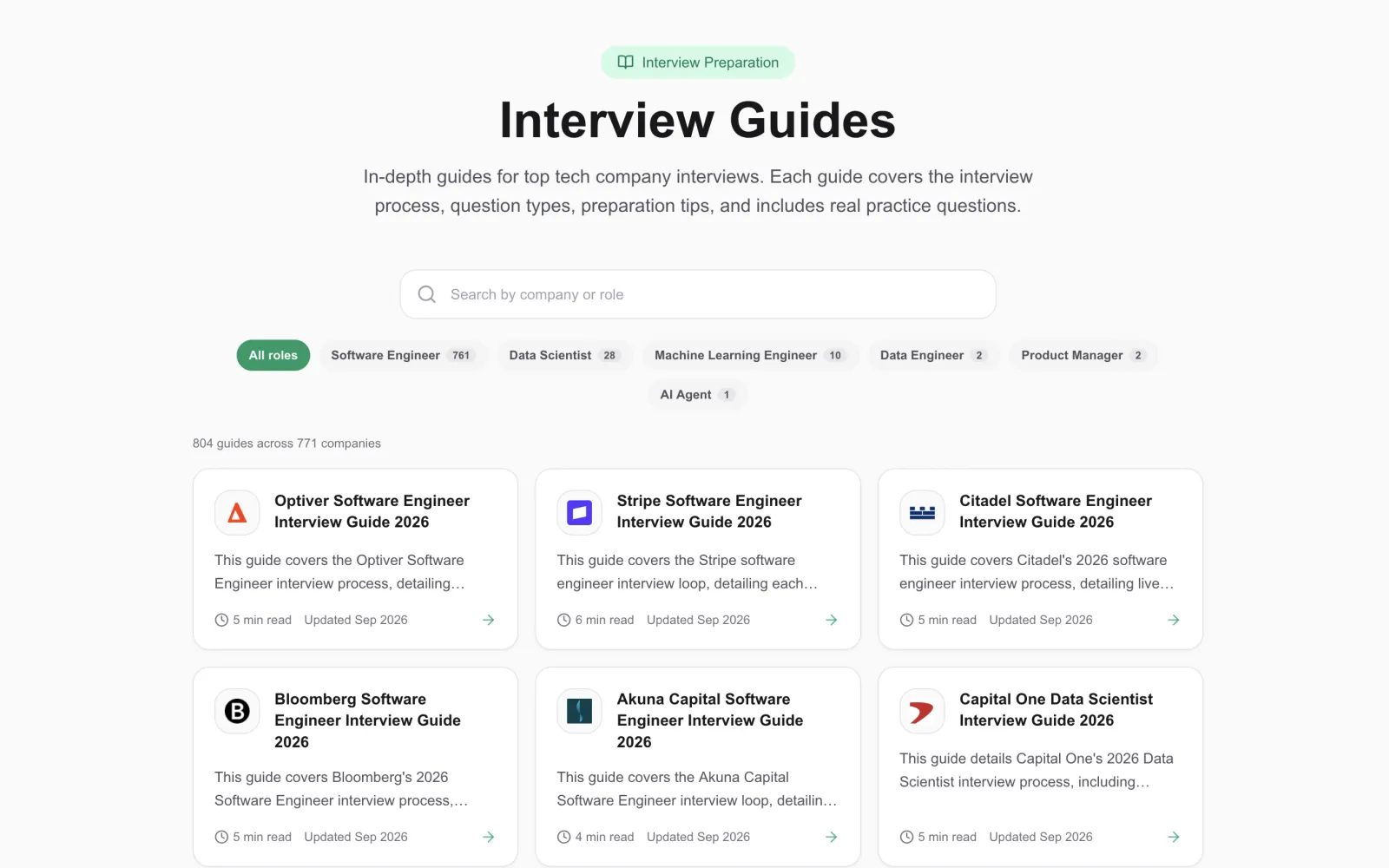
The Stripe software engineer guide shows how deep these go. It includes:
- a difficulty breakdown based on 90 labeled questions
- a topic split showing what Stripe tests (58% coding, 13% behavioral, 11% system design)
- the questions most likely to come up, sorted by popularity
- a table of every interview round with length, primary signal and where to focus your prep
- a two-week preparation plan
- an embedded candidate video and an FAQ

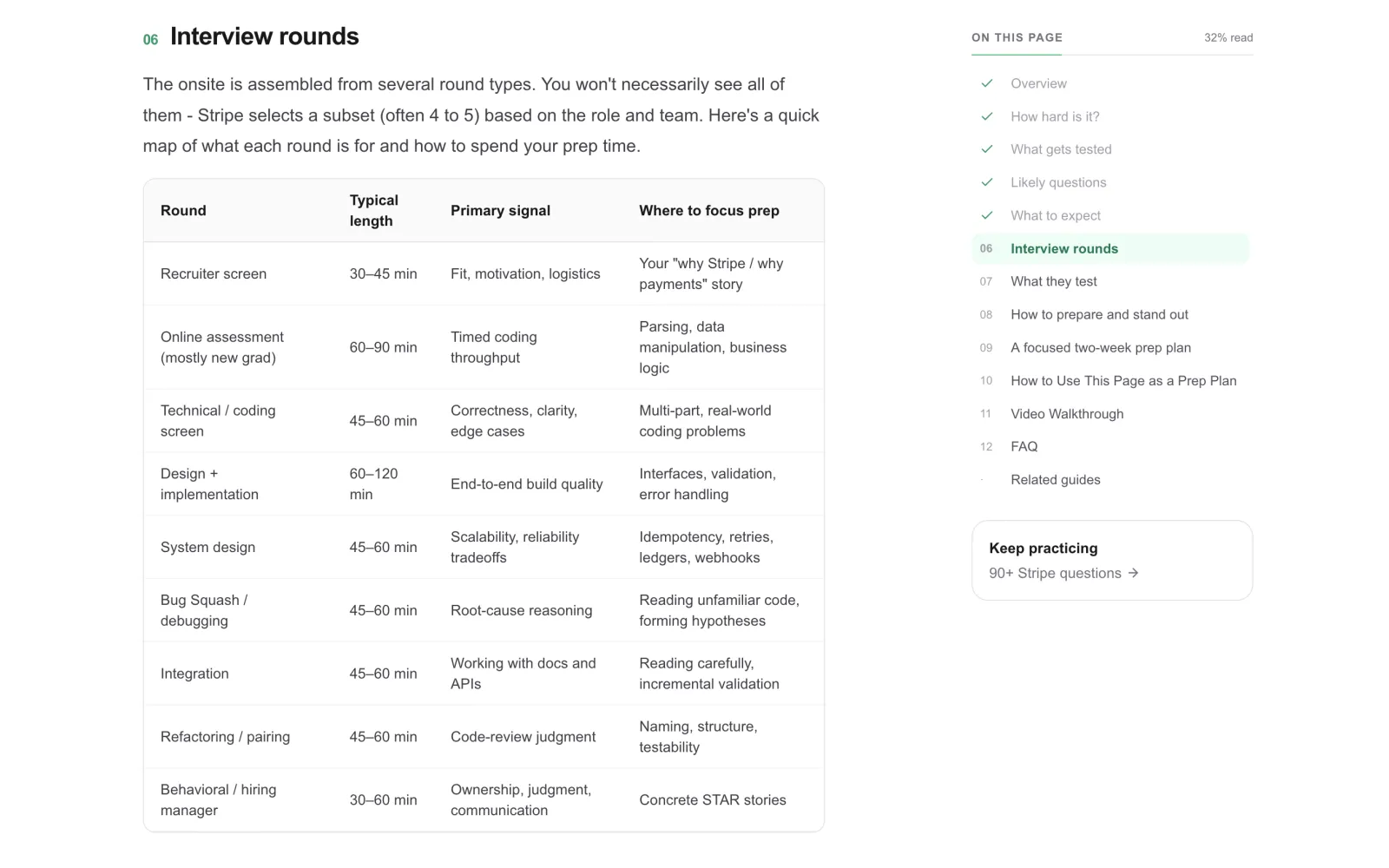
The explanations of company-specific formats are especially useful, like Stripe’s “Bug Squash” round where you hunt for defects in unfamiliar code. If you have never heard of that round, you walk into one of the hardest parts of the loop unprepared.
Quality does vary with the available data. The Stripe guide draws on 49 experience reports. For smaller companies with only a handful of reports, a guide will inevitably stay more general.
Personalized cheatsheets
Cheatsheets give you a study overview for a specific company and role, for example “OpenAI Software Engineer”. PracHub organizes the material by interview stage and topic and estimates the study time for each stage.
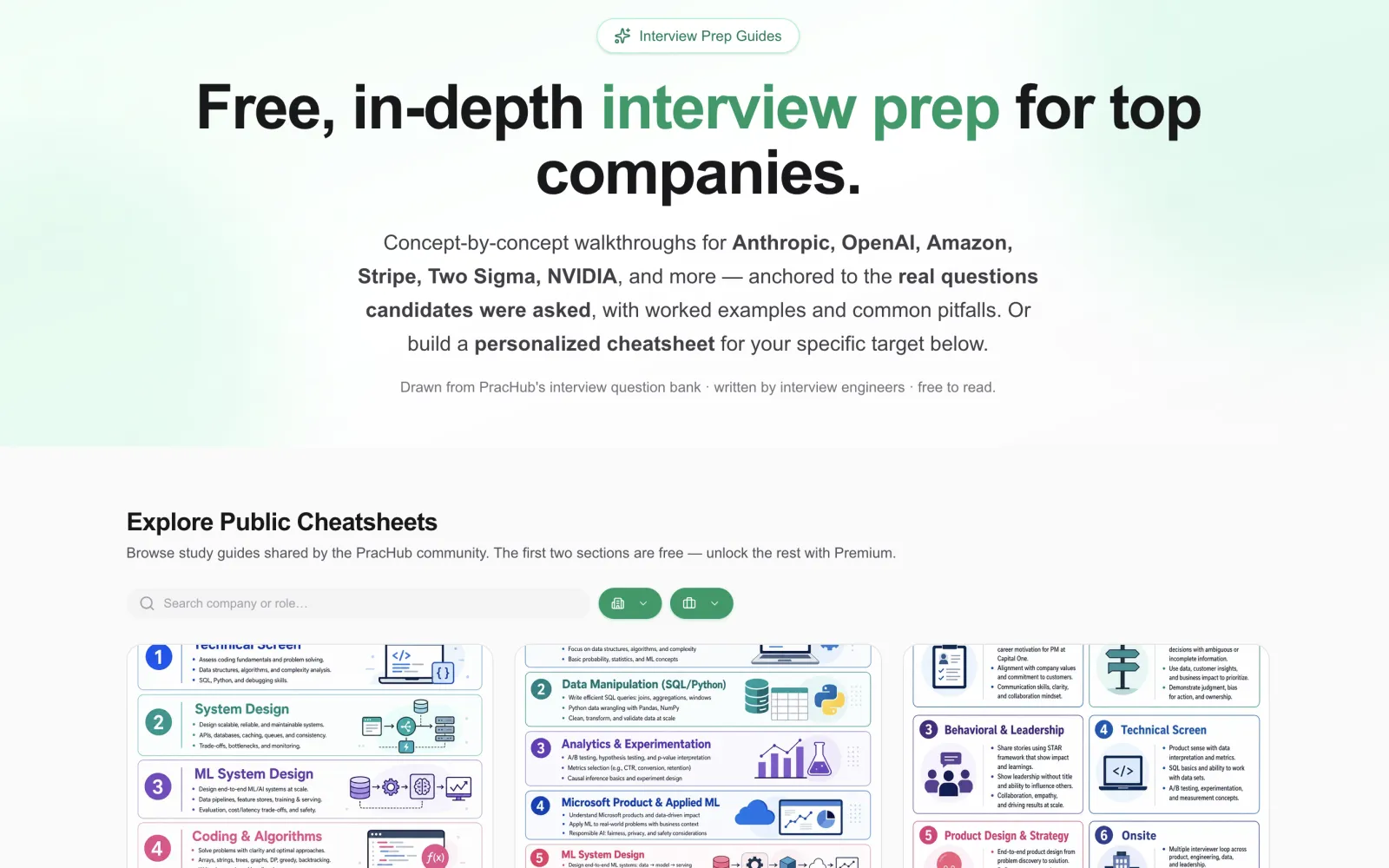
Each topic comes with a detailed architecture diagram, an explanation of what is being tested, adjacent topics an interviewer may pivot to, further reading and matching practice questions. For OpenAI that includes GPU credit ledgers, LLM API gateways with rate limits and sandboxing for cloud IDEs. The cheatsheet also takes your own progress into account and flags a topic as a focus area when you have not solved any questions in it yet.

You can browse public cheatsheets shared by the community. The first two sections are free, and the rest requires Premium.
How do I know the questions really come from these companies?
This is the most important question for any platform of this kind, and PracHub cannot fully answer it. No company publishes its interview questions. Everything on PracHub comes from candidate reports and passes through editorial work.
Some signals support its credibility:
- Every question carries company, role, round and date, so you can check how recent it is.
- The “Experience” toggle shows the report a question came from.
- Rejections and bad experiences get published too.
- PracHub itself points out when a source reflects a single candidate’s view, as with the video in the Stripe guide.
On the other side, many questions have clearly been rewritten and expanded. The Microsoft conflict question reads more like a polished practice task than something an interviewer said word for word. Some questions in the OpenAI cheatsheet are more than a year old and nobody has solved them yet.

Our advice: use PracHub to understand which topics and formats a company tests. Do not count on getting that exact question word for word. The most reliable source for your own loop is your recruiter. Ask for an overview of the rounds, which is common practice at large tech companies.
What PracHub cannot do
PracHub is a knowledge platform. Nobody listens while you explain a solution, and nobody tells you whether your STAR story is convincing. Yet that is exactly where many technically well-prepared candidates fail.
If you are applying in Germany, a few more gaps show up. The guides focus on US companies, trading firms and big tech. You will find very little about German employers, the German-language HR interview or salary negotiation by German standards. Our guides on the HR interview in German tech and salary negotiation in German tech cover that ground.
Our recommendation is to pair PracHub with real interview simulation. Our comparison of mock interview options shows how peer platforms, AI tools and professional coaching differ.
How much does PracHub Premium cost?
PracHub sells Premium in three billing periods. All of them include full question bank access, detailed solutions, community discussions, every course and an AI mentor with up to 50 sessions per day.
| Plan | Price | Per month |
|---|---|---|
| Monthly | $27.99 per month | $27.99 |
| Quarterly | $79.99 every 3 months | $26.66 |
| Yearly | $119.99 per year | $10.00 |
Prices in US dollars as of September 2026. PracHub presents them as discounts on higher list prices, so they may change.
According to the pricing page, only the yearly plan includes “Updates & New Content”. On the monthly and quarterly plans, “Lifetime Updates” is greyed out.
The math is simple. The quarterly plan saves you almost nothing over paying monthly. If there is any chance your preparation runs longer than three months, the yearly plan costs less than two quarters. It even beats the monthly plan from the fifth month on.
Pros and cons
| Pros | Cons |
|---|---|
| Very large, current question bank with precise filters | Origin of individual questions cannot be verified |
| Detailed company guides with round-by-round breakdowns | Guide quality depends on how much data exists |
| Behavioral questions with model answers and follow-ups | No notebooks for data science tasks |
| Strong courses on ML, GenAI and AI agents | Little content on German employers |
| Generous free tier for testing | No feedback from real interviewers |
| Personalized cheatsheets per company | Coverage skews toward US companies |
| Yearly plan works out to only $10 a month | Monthly plan is expensive by comparison |
Verdict: who should use PracHub?
PracHub is worth it above all when you have a concrete interview coming up at a large international tech company. The company guides and the filterable question bank save you hours of digging through forums and Glassdoor. The platform is particularly strong for ML engineers and anyone targeting AI companies like OpenAI or Anthropic, because comparably organized material on those loops is hard to find.
It is a weaker fit if you are mainly applying to German companies, or if you are just starting out and still need to learn algorithm fundamentals.
How we would approach it: start with the free tier. Read the guide for your target company and work through the free course lessons. If the material matches your process, Premium is worth it. For a single interview in the next few weeks, the monthly plan is enough. If you expect a longer job search, go straight for the yearly plan at $119.99.
Once your content prep is done and you want to find out how you come across in the room, our coaches can help. At CodingCareer, former FAANG interviewers run realistic mock interviews in English and German and give you concrete feedback. Learn more about our FAANG coaching or read our guide to FAANG interview preparation.
FAQ
Is PracHub free?
Partly. You can browse the question bank, the interview experiences and the company guides without paying. Every course opens with free lessons, between 2 and 14 depending on the course. On the cheatsheets, the first two sections are free. Individual premium questions, the remaining course lessons and the rest of each cheatsheet require PracHub Premium. Premium costs $27.99 per month, $79.99 per quarter or $119.99 per year (as of September 2026).
Do the questions on PracHub really come from the companies?
Nobody outside the company can prove that. PracHub collects questions from candidate reports and tags each one with company, role, round and date. These are not official question lists from the employers, and some questions have clearly been rewritten and expanded by editors. Treat them as a realistic picture of the topics a company tests, and confirm important details with Glassdoor, Blind or your recruiter.
Is PracHub useful if I am applying for jobs in Germany?
For international tech companies with offices in Germany, such as Google, Amazon, Microsoft or Stripe, PracHub is a strong resource because their interview loops look similar worldwide. For German Mittelstand companies, corporates or local startups you will find very little material. Topics like the German-language HR interview or salary negotiation by German standards are not covered.
Does PracHub offer interactive notebooks for data science?
No. Data science tasks such as computing a precision-recall curve are shown as text with community answers. There is no runnable Jupyter-style notebook. The only place where you can execute code in the browser is the editable Python console in the Practical Python course.
What is a good alternative or complement to PracHub?
For pure algorithm practice, LeetCode is still the standard. For interview simulation with feedback you need real people, either peer platforms or professional mock interviews. PracHub cannot replace that practice because nobody evaluates your answers live. At CodingCareer, former FAANG interviewers run mock interviews in English and German.